 |
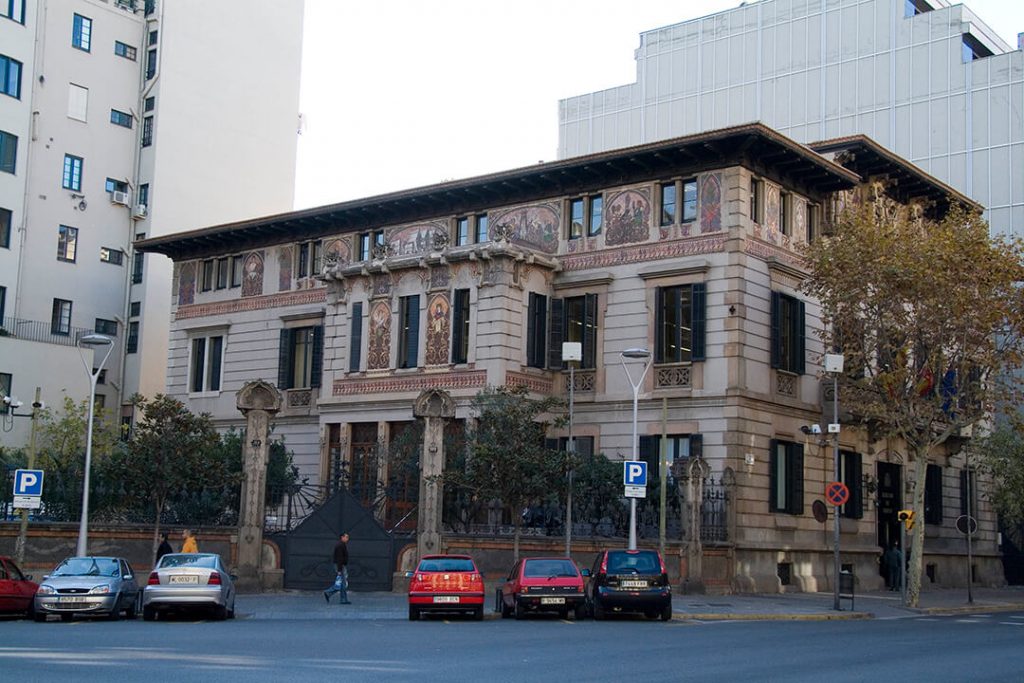
Palau del Baró de Quadras
Address Diagonal, 373. Open Library: Monday to Friday 10am to 8pm, Saturdays 10am to 2pm. Exhibitions: Tuesday to Saturday 10am to 8pm, Sundays and holidays 10am to 2pm.Closed on December 24th, 25th, 26th and 31st and January 1st and 2nd.
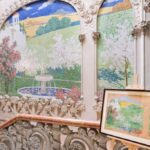
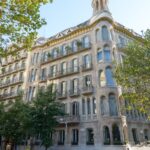
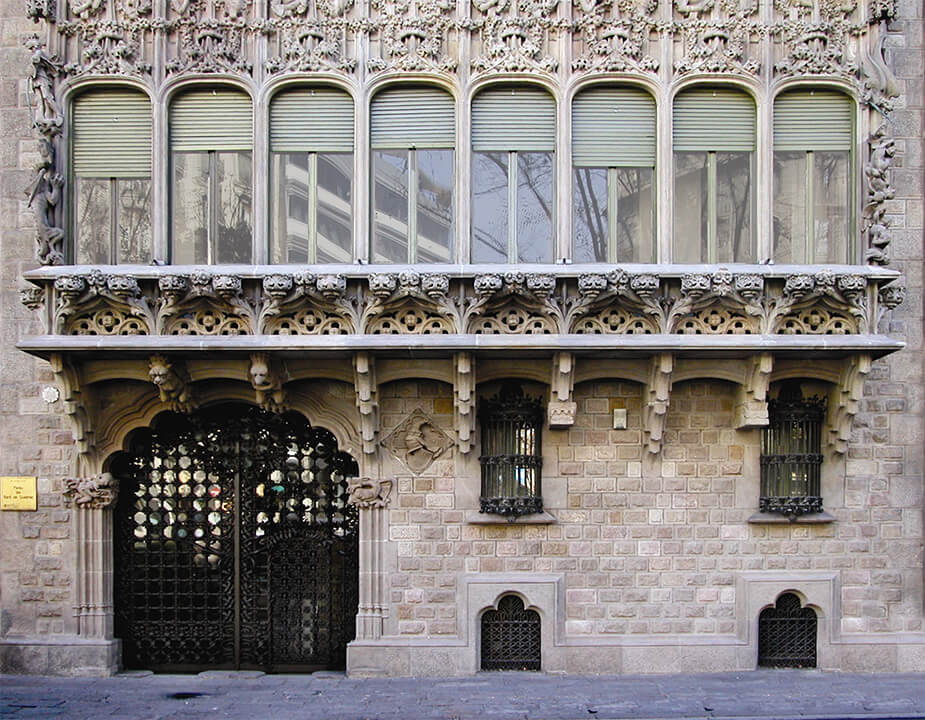
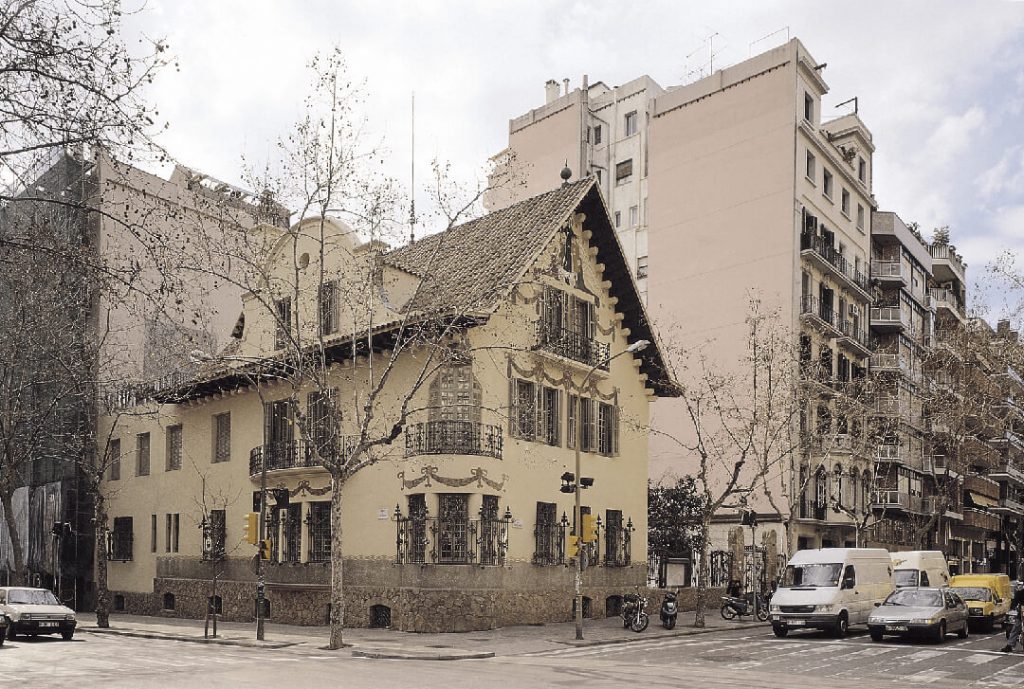
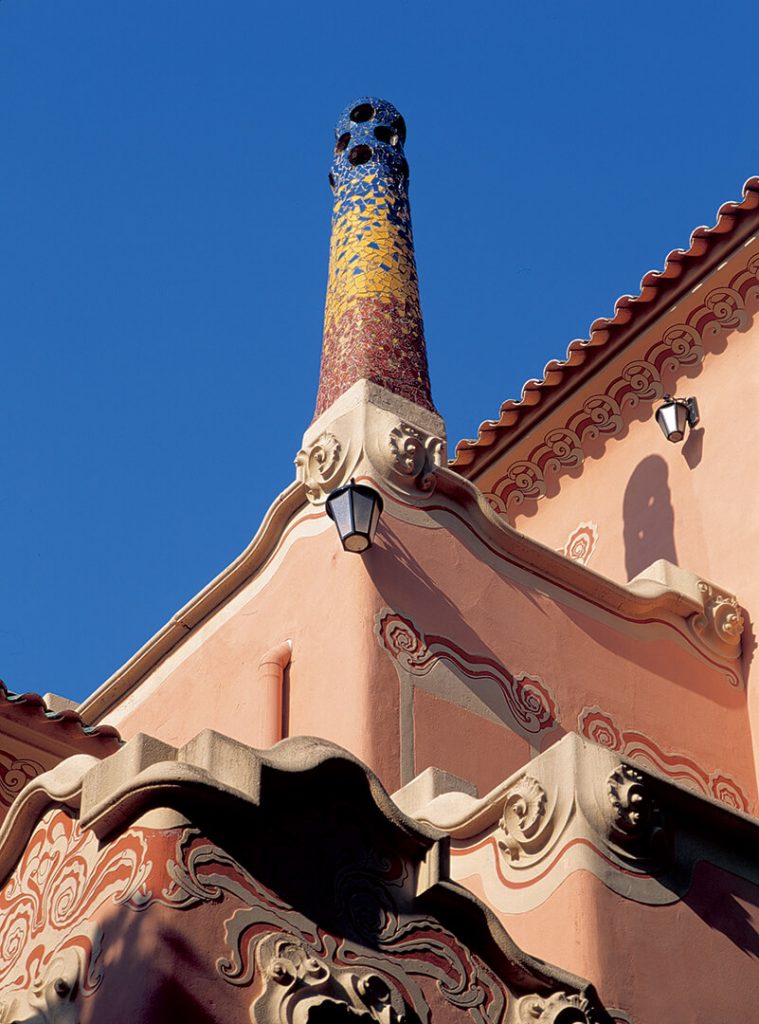
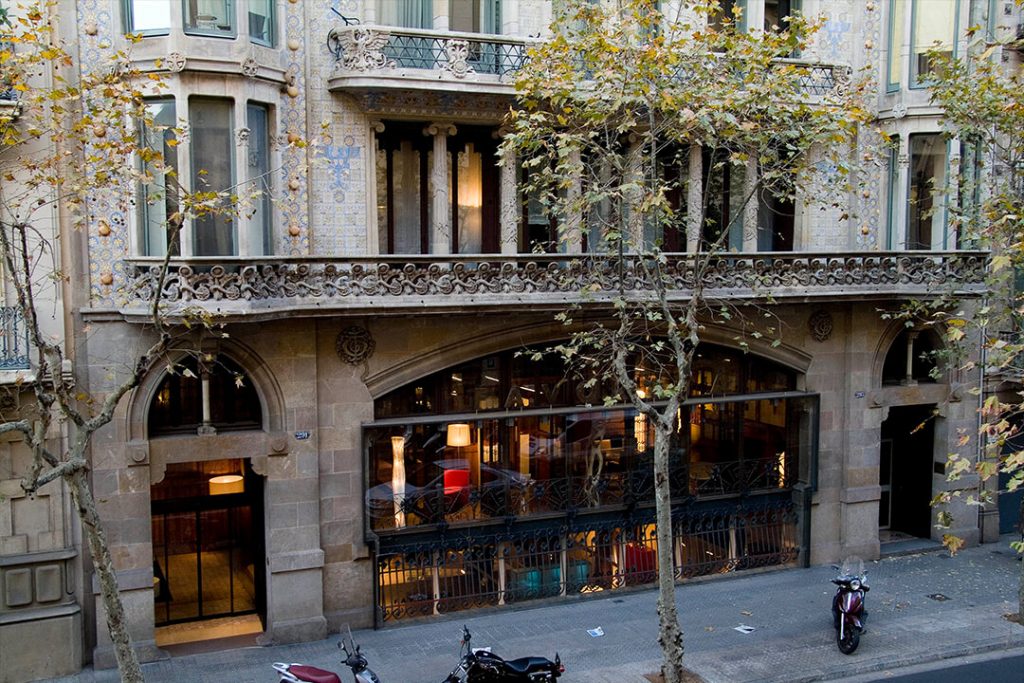
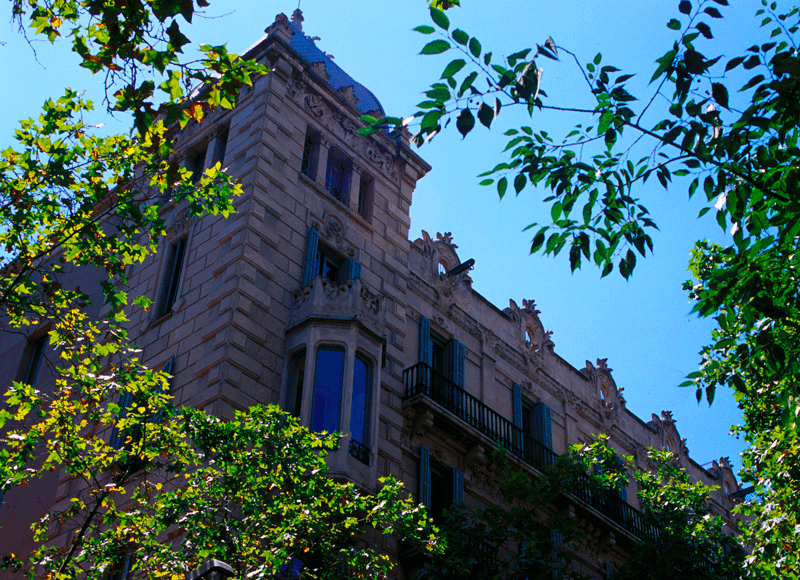
Information Tel. 932 387 337. www.casaasia.es Further details Timetables may vary. Description Built in 1904, it is now the premises of the House of Asia (Casa Àsia, tel. 932 387 337, www.casaasia.es), a public institution set up in 2001 with the aim of promoting actions and projects to foster development with Asia in the institutional, cultural, academic and economic spheres. The mansion is a veritable compendium of Puig i Cadafalch’s capacity for design and elegance. Everything is exemplary: from the wrought iron door to the interior, with a highly ornamented foyer. One of the curiosities is the building’s double façade. The façade giving onto Avinguda Diagonal emphasises the noble nature of the mansion, and combines Gothic and Plateresque forms with an abundant floral decoration. The rear façade (giving onto Carrer Rosselló) reveals that the building was in origin not a palace, but a simple block of flats. The Arabic-style interior contains Roman mosaics, polychrome woodwork, sgraffito work and wooden lattices. |
|
|
Back on Avinguda Diagonal, going towards Passeig de Sant Joan,
the Route comes to a building by Josep Puig i Cadafalch, the
PALAU DEL BARÓ
DE QUADRAS. (76) (Diagonal, 373). Built in 1904, it
is now the premises of the House of Asia (Casa Àsia,
tel. 932 387 337, www.casaasia.es), a public institution set
up in 2001 with the aim of promoting actions and projects
to foster development with Asia in the institutional, cultural,
academic and economic spheres. The mansion is a veritable
compendium of Puig i Cadafalch’s capacity for design
and elegance. Everything is exemplary: from the wrought iron
door to the interior, with a highly ornamented foyer. One
of the curiosities is the building’s double façade.
The façade giving onto Avinguda Diagonal emphasises
the noble nature of the mansion, and combines Gothic and Plateresque
forms with an abundant floral decoration. The rear façade
(giving onto Carrer Rosselló) reveals that the building
was in origin not a palace, but a simple block of flats. The
Arabic-style interior contains Roman mosaics, polychrome woodwork,
sgraffito work and wooden lattices.
On the opposite side of the avenue is the CASA
COMALAT (77) (Diagonal, 442) by Salvador Valeri i Popurull.
This unusual and spectacular work (1909-1911), which is highly
influenced by Gaudí, is also particularly interesting
for its two façades: the main façade, which
is symmetrical and urban, and the rear façade (on Carrer
Còrsega), which is less formal, polychrome and decorated
with peculiar Modernista wooden galleries with blinds and
coloured ceramic work. The interior is no less impressive,
with mosaic paving and exquisite furniture featuring unusually
shaped benches and the peculiar foyer lights.
On the same side of Avinguda Diagonal, at
the intersection with Carrer Rosselló and Carrer Roger
de Llúria, is the CASA
TERRADES (78) (Diagonal, 416-420). This imposing building,
known popularly as CASA
DE LES PUNXES, (HOUSE OF THE SPIRES), was built in
1905 by Josep Puig i Cadafalch on a large site owned by the
Terrades sisters. With a striking and characteristic silhouette,
Casa de les Punxes is one of the most famous Modernista works.
Though it seems to be a uniform block, it is in fact composed
of three apartment houses. In its construction, Puig i Cadafalch
exaggerated his highly stylised traditional medieval elements
to the point that the building looks like a castle. It has
four round towers crowned by conical turrets, a main tower
with a dome and a host of bay windows and belvederes in Flamboyant
Gothic style. The Australian writer Robert Hughes described
it in his book Barcelona as “a cross between a Flemish
guildhall and a medievalising Mad Ludwig (referring to Louis
2nd, King of Bavaria) schloss”. Its spectacular façade
is clad in brick, except on the ground floor where stone is
used, and it features wrought iron work, balconies and ceramic
panels depicting patriotic motifs. One of these, the largest
and best-known, represents Saint George and proudly bears
the following legend: “Sant Patró de Catalunya,
torneu-nos la llibertat” (“Holy Patron of Catalonia,
give us back our freedom”) which at the time was considered
by some to be a provocation. The fiery politician Alejandro
Lerroux called it “a crime against the nation”
(the Spanish nation, in this case), but art prevailed over
politics and the panel was preserved -even during fascism
and with a police station in front of it!
Continuing along Avinguda Diagonal we come
to Plaça Mossèn Jacint Verdaguer, presided over
by a monument to Verdaguer, the nineteenth-century “National
Poet of Catalonia”. The monument was designed in 1914
by a Josep M. Pericas that was already evolving, moving away
from Modernisme: the statue is by Joan Borrell, and the stone
reliefs by the Oslé brothers. From this square one
can see the CASA MACAYA
(79) (Passeig de Sant Joan, 108), an urban residence built
by Josep Puig i Cadafalch in 1901. This mansion is another
medievalistic experiment by the Catalan architect. The white
façade of the palace, culminating in two side turrets,
has sgraffito work and openings with sculptural decoration,
including capitals by Eusebi Arnau depicting very contemporary
subjects, such as the cyclist beside the main door. The highly
ornamental decoration of the interior has almost all been
lost except for the foyer, decorated with sgraffito work and
tiles, and the courtyard with an open staircase in the purest
style of the medieval mansions of Barcelona.
Returning to the Diagonal and going east
towards Plaça de les Glòries we find, at the
corner of Carrer Sicilia, the CASA
PLANELLS (80) (Diagonal, 332), an original building
of rounded forms built in 1924 by Josep Maria Jujol i Gibert,
a student of Gaudí. Many specialists consider this
house as the last Modernista work in Barcelona, but the influence
of new avant-garde and rationalist trends is evident. Jujol
did an admirable job of using a small site to design maisonettes
connected by interior spiral stairs.
Going up Carrer Sicilia and turning right
at Carrer Mallorca we reach the TEMPLE
EXPIATORI DE LA SAGRADA FAMÍLIA. (81 (EXPIATORY
TEMPLE OF THE HOLY FAMILY). Gaudí was a unique architect
in his time, and one of the few in the history of architecture
to have had a commission that lasted a lifetime -in fact,
a commission that outlived him. The Sagrada Família
is a work of great brilliance and ambition and of giant aspirations.
Temple Expiatori de la Sagrada Família
Address Mallorca, 401. Open All year round except January 1st and 6th and December 25th and 26th. October to March, 9am to 6pm; April to September 9am to 8pm.
Information Tel.: 932 080 414. www.sagradafamilia.org Further details Timetables may vary. Prices and discounts Prices. Adults: €12.00.
Pensioners and children under 18 years of age: €9.00.
Groups: €10.00 per person (over 20 persons).
From 0 to 10 years-old: free entrance.
Adults+guided tour: €16.00.
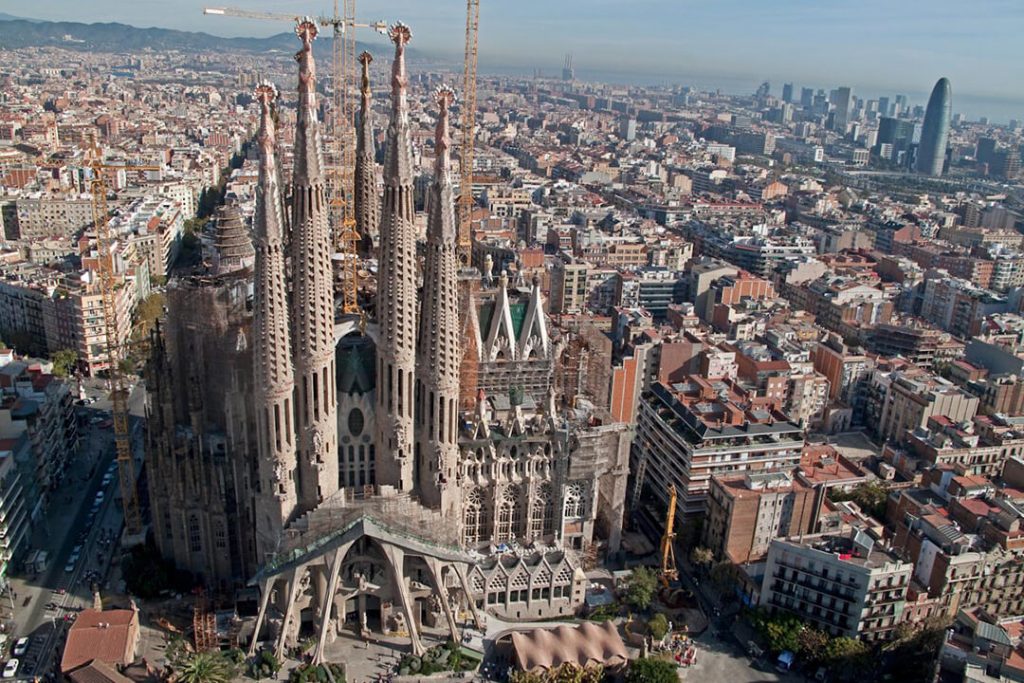
With the discount of the Modernisme Route: €11,00 (adult price). Description Going up Carrer Sicilia and turning right at Carrer Mallorca we reach the TEMPLE EXPIATORI DE LA SAGRADA FAMÍLIA. (81 (EXPIATORY TEMPLE OF THE HOLY FAMILY). Gaudí was a unique architect in his time, and one of the few in the history of architecture to have had a commission that lasted a lifetime -in fact, a commission that outlived him. The Sagrada Família is a work of great brilliance and ambition and of giant aspirations. The origin of the Expiatory Church of the Holy Family dates back to 1869 when Josep M. Bocabella, founder of the Josephite Association dedicated to fostering devotion to Saint Joseph, had the idea of building a church to honour the Holy Family (Saint Joseph, the Virgin Mary and Jesus Christ). Bocabella bought a site and in 1882 started to build a church in a Neo-Gothic style with the aim of creating a cathedral for the poor, to counteract the anticlerical radicalism that was beginning to spread among the lower classes of Barcelona (the city anarchist leader Mikhail Bakunin had pointed out as the most revolutionary in all of Europe). However, in the course of time the church took on a very different meaning as conservative Catalan nationalists began to identify with the project. The initial design of the church was by Francesc de Paula Villar, but the lack of understanding between the owner and the architect led to a radical change of plans. Villar was dismissed and replaced by Antoni Gaudí, who finished the crypt and presented a new, far more ambitious plan: to build a cathedral with a great, central, 170-metre-high tower dedicated to the Saviour. Pious Mr. Bocabella was thrilled with the idea and Gaudí plunged into the project. Progress, however, was not easy. In 1891 he started work on the Nativity façade: thirty-four years later, in 1925, Gaudí had finished only the first of the four bell towers that crown this façade. The other three were finished after the death of the architect.
The Sagrada Família may be considered a Bible in stone, owing to the great number of Christian symbols that Gaudí placed on its façades. These include, or rather will include once finished, Adam and Eve, the Twelve Apostles, all the episodes of the life of Jesus and all the main symbols of the Old Testament. The Sagrada Família is, indeed, a monument that could be used as an introductory crash-course to Catholic religion. The importance of this building is not, however, exclusively religious. It is also the “book of Gaudí”, the clearest lesson of his way of building, a kind of testament in which Gaudí applied all the structural solutions that he had studied and tested in his different works. The work where he paid his last homage to nature, which he called “the best builder” and which he always strove to imitate. One can see this clearly in the way the church is supported on leaning columns whose branches support small hyperboloid sections of vault, producing the effect of a forest.
The Nativity Façade, on Carrer Marina, is Gaudí’s great work. Almost completed by the architect, it attempts to express and communicate the joy of creation through the birth of Jesus. In the central archivolt, one can see Jesus, Joseph and Mary under the Star of Bethlehem and with the ox and the mule, surrounded by angels, musicians and singers. A careful examination of the façade’s decoration reveals over a hundred plant species and a hundred animals sculpted on the archivolts and ribs. This façade has three doors. The central one is the Door of Charity, inscribed with the names of the genealogy of Christ, from the beginning of the snake with the apple to the baby Jesus with the ox and the mule, and the signs of the Zodiac as they were on the day of Christ’s birth. On the south side is the Door of Hope, representing the marriage of Joseph and Mary, the flight to Egypt, the massacre of the innocents and a representation of the Montserrat mountain with the inscription “Salveu-nos” (“Save us”: Montserrat Mountain is traditionally considered a holy mountain and the Virgin of Montserrat the patron of Catalonia). On the opposite side is the Door of Faith representing the scenes of the Visitation; Jesus among the wise men in the temple and at his carpenter’s bench. The pinnacles of this façade resemble ears of corn and bunches of grapes, presided by the image of Mary as the Immaculate Conception. The façade as a whole celebrates the triumph of life.
The Passion Façade on Carrer Sardenya is the counterpoint to the Nativity Façade. This façade includes over a hundred contemporary sculptures evoking the Passion by the sculptor Josep Maria Subirachs. Desolation, nudity, pain and sacrifice all accompany the death of Christ to announce his resurrection and ascent to heaven. Gaudí often repeated that, had he started with this façade, people would have rejected the Sagrada Família outright. In contrast with the decorated, ornamented and turgid Nativity Façade, the Passion Door is harsh and naked, as if it were made of bones. Through a larger portico supported by six large leaning columns as sequoia tree trunks, an immense pediment rises with 18 smaller columns supporting an inner portico. The lack of decoration concentrates the tragedy in the dramatic main events, presided by the naked figure of Christ at the moment of his death. The main façade, which will represent the life and destiny of man, is still to be built. According to Gaudí’s plan, it will face the sea looking over Carrer Mallorca, which would be covered by a large plaza reached by a huge staircase rising from what today is the doomed block of houses facing the temple. What is beginning to take shape is totally new forms in the naves of the church, which show unusual geometrical and structural solutions. The naves of the church are the result of years of study and reflection: it wasn’t until 1910 that Gaudí started the study of the naves, incorporating the experience he had acquired in the chapel of the Colònia Güell. However, the discovery of the luminosity of the hyperboloid led Gaudí to use concave-convex domes fitted to columns, walls and windows. At a scale of 1/10, this was the vision of the forest that he often used to explain his design. The museum of the church conserves the history of its construction in site plans, photographs of different periods of the construction, fragments of models, iconography and wrought iron, wood and metal work designed by Gaudí, in addition to photographs and an audiovisual presentation on other buildings by the same architect. One can also see the models of the central nave and the façades. The most outstanding exhibits are the model that was used to calculate the structure of the church of the Colònia Güell (a solution including slightly helicoidal columns and paraboloid-helicoid arches) and a score of original drawings by the architect. There are also photographs of other buildings by Gaudí and elements that he designed and that were modelled in the workshops of the church. One of the adjoining facilities is the Sagrada Família Schools, a simple curvilinear building with the stamp of Gaudí that dazzled Le Corbusier with its technical boldness. These schools, originally intended for the children of the builders who were working on the site, form an innovative building in which Gaudí did not use iron and made all the structures with brick, thus achieving great plasticity with a very cheap material.
|
|
|
The origin of the Expiatory Church of the
Holy Family dates back to 1869 when Josep M. Bocabella, founder
of the Josephite Association dedicated to fostering devotion
to Saint Joseph, had the idea of building a church to honour
the Holy Family (Saint Joseph, the Virgin Mary and Jesus Christ).
Bocabella bought a site and in 1882 started to build a church
in a Neo-Gothic style with the aim of creating a cathedral
for the poor, to counteract the anticlerical radicalism that
was beginning to spread among the lower classes of Barcelona
(the city anarchist leader Mikhail Bakunin had pointed out
as the most revolutionary in all of Europe). However, in the
course of time the church took on a very different meaning
as conservative Catalan nationalists began to identify with
the project. The initial design of the church was by Francesc
de Paula Villar, but the lack of understanding between the
owner and the architect led to a radical change of plans.
Villar was dismissed and replaced by Antoni Gaudí,
who finished the crypt and presented a new, far more ambitious
plan: to build a cathedral with a great, central, 170-metre-high
tower dedicated to the Saviour. Pious Mr. Bocabella was thrilled
with the idea and Gaudí plunged into the project. Progress,
however, was not easy. In 1891 he started work on the Nativity
façade: thirty-four years later, in 1925, Gaudí
had finished only the first of the four bell towers that crown
this façade. The other three were finished after the
death of the architect.
The Sagrada Família may be considered
a Bible in stone, owing to the great number of Christian symbols
that Gaudí placed on its façades. These include,
or rather will include once finished, Adam and Eve, the Twelve
Apostles, all the episodes of the life of Jesus and all the
main symbols of the Old Testament. The Sagrada Família
is, indeed, a monument that could be used as an introductory
crash-course to Catholic religion. The importance of this
building is not, however, exclusively religious. It is also
the “book of Gaudí”, the clearest lesson
of his way of building, a kind of testament in which Gaudí
applied all the structural solutions that he had studied and
tested in his different works. The work where he paid his
last homage to nature, which he called “the best builder”
and which he always strove to imitate. One can see this clearly
in the way the church is supported on leaning columns whose
branches support small hyperboloid sections of vault, producing
the effect of a forest.
The Nativity Façade, on Carrer Marina,
is Gaudí’s great work. Almost completed by the
architect, it attempts to express and communicate the joy
of creation through the birth of Jesus. In the central archivolt,
one can see Jesus, Joseph and Mary under the Star of Bethlehem
and with the ox and the mule, surrounded by angels, musicians
and singers. A careful examination of the façade’s
decoration reveals over a hundred plant species and a hundred
animals sculpted on the archivolts and ribs. This façade
has three doors. The central one is the Door of Charity, inscribed
with the names of the genealogy of Christ, from the beginning
of the snake with the apple to the baby Jesus with the ox
and the mule, and the signs of the Zodiac as they were on
the day of Christ’s birth. On the south side is the
Door of Hope, representing the marriage of Joseph and Mary,
the flight to Egypt, the massacre of the innocents and a representation
of the Montserrat mountain with the inscription “Salveu-nos”
(“Save us”: Montserrat Mountain is traditionally
considered a holy mountain and the Virgin of Montserrat the
patron of Catalonia). On the opposite side is the Door of
Faith representing the scenes of the Visitation; Jesus among
the wise men in the temple and at his carpenter’s bench.
The pinnacles of this façade resemble ears of corn
and bunches of grapes, presided by the image of Mary as the
Immaculate Conception. The façade as a whole celebrates
the triumph of life.
The Passion Façade on Carrer Sardenya is the counterpoint
to the Nativity Façade. This façade includes
over a hundred contemporary sculptures evoking the Passion
by the sculptor Josep Maria Subirachs. Desolation, nudity,
pain and sacrifice all accompany the death of Christ to announce
his resurrection and ascent to heaven. Gaudí often
repeated that, had he started with this façade, people
would have rejected the Sagrada Família outright. In
contrast with the decorated, ornamented and turgid Nativity
Façade, the Passion Door is harsh and naked, as if
it were made of bones. Through a larger portico supported
by six large leaning columns as sequoia tree trunks, an immense
pediment rises with 18 smaller columns supporting an inner
portico. The lack of decoration concentrates the tragedy in
the dramatic main events, presided by the naked figure of
Christ at the moment of his death.
The main façade, which will represent the life and
destiny of man, is still to be built. According to Gaudí’s
plan, it will face the sea looking over Carrer Mallorca, which
would be covered by a large plaza reached by a huge staircase
rising from what today is the doomed block of houses facing
the temple. What is beginning to take shape is totally new
forms in the naves of the church, which show unusual geometrical
and structural solutions. The naves of the church are the
result of years of study and reflection: it wasn’t until
1910 that Gaudí started the study of the naves, incorporating
the experience he had acquired in the chapel of the Colònia
Güell. However, the discovery of the luminosity of the
hyperboloid led Gaudí to use concave-convex domes fitted
to columns, walls and windows. At a scale of 1/10, this was
the vision of the forest that he often used to explain his
design.
The museum of the church conserves the history of its construction
in site plans, photographs of different periods of the construction,
fragments of models, iconography and wrought iron, wood and
metal work designed by Gaudí, in addition to photographs
and an audiovisual presentation on other buildings by the
same architect. One can also see the models of the central
nave and the façades. The most outstanding exhibits
are the model that was used to calculate the structure of
the church of the Colònia Güell (a solution including
slightly helicoidal columns and paraboloid-helicoid arches)
and a score of original drawings by the architect. There are
also photographs of other buildings by Gaudí and elements
that he designed and that were modelled in the workshops of
the church. One of the adjoining facilities is the Sagrada
Família Schools, a simple curvilinear building with
the stamp of Gaudí that dazzled Le Corbusier with its
technical boldness. These schools, originally intended for
the children of the builders who were working on the site,
form an innovative building in which Gaudí did not
use iron and made all the structures with brick, thus achieving
great plasticity with a very cheap material.
From the Nativity Façade of the Sagrada
Família, on Carrer Marina, one can see the start of
Avinguda Gaudí, adorned with a sculpture by Apel·les
Fenosa and the old Modernista street lamps by Pere Falqués
which used to stand at the the Cinc d’Oros, on the crossing
of Diagonal with Passeig de Gràcia. Avinguda Gaudí
leads to the HOSPITAL
DE LA SANTA CREU I SANT PAU (82) (HOSPITAL OF THE HOLY
CROSS AND OF SAINT PAUL) wich stands at the opposite end of
the avenue. Construction of the current premises began in
1902, following a design by Lluís Domènech i
Montaner, who was sensitive to the new hygienist theories
of public health applied to town planning promoted by the
doctor Pere Felip Monlau and engineers Ildefons Cerdà
and Pere García Faria (designer of the Barcelona underground
sewage network in the 19th century).
Hospital de la Santa Creu i Sant Pau. Recinte històric.
Address Sant Antoni Maria Claret, 167. Open
Modernisme Centre: daily from 9.30 am to 1.30 pm.
Guided tours:
10.00h ENGLISH
10.30h French
11.00h ENGLISH
11.30h Spanish
12.00h ENGLISH
12.30h Catalan
13.00h ENGLISH
Previous booking visits:
daily in Catalan, Spanish, English or French.
Closed on January 1st and 6th and December 25th and 26th. Information
Tel.: 933 177 652. www.rutadelmodernisme.com Further details
RESTRICTED ACCESS DUE TO WORK ON THE SANT PAU MODERNISTA COMPLEX
From 19/11/2009, public access will be restricted to the main part of the Hospital de Sant Pau Modernista complex due to renovation work on the hospital’s Modernista pavilions. Access to the historical complex will only be allowed as part of Barcelona Modernisme Route guided tours, with the same times. As has occurred until now, the tours will begin at the entrance of the main building (corner Sant Antoni M. Claret / Cartagena) and at the same times.
Prices and discounts Price: Adults €10.00.
Pensioners and children under 18 years of age €5.00.
Discount of the Modernisme Route: 50%.
Guided tours for groups. Must be reserved by calling: 932 562 504 or sending an e-mail to: cultura-impuqv@bcn.cat
Price: €150,00.
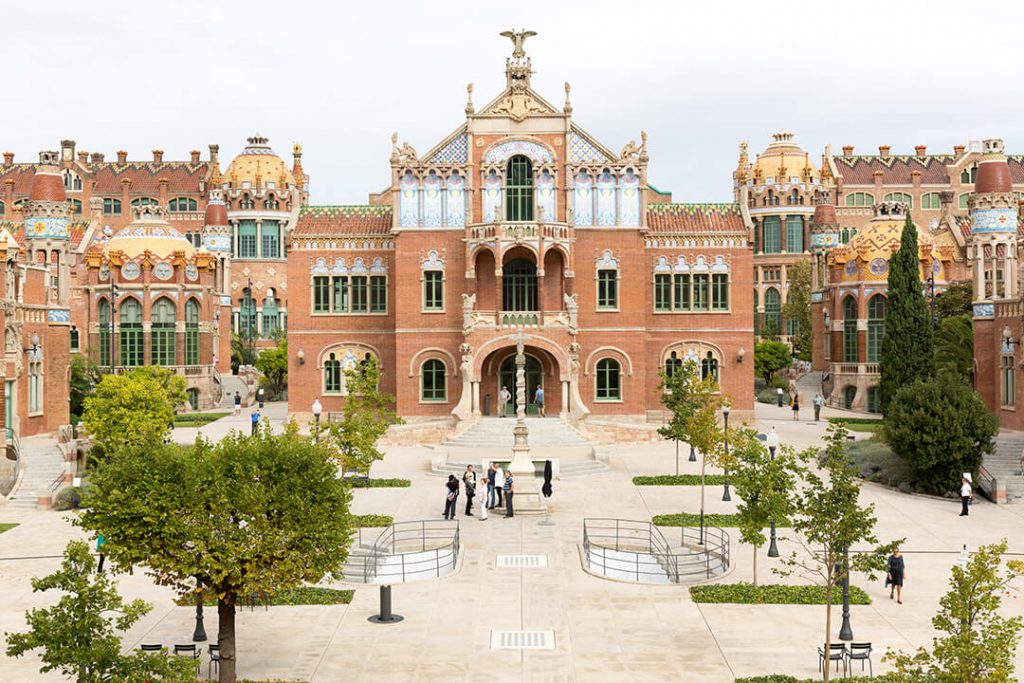
School groups: €120,00 Description Avinguda Gaudí leads to the HOSPITAL DE LA SANTA CREU I SANT PAU (82) (HOSPITAL OF THE HOLY CROSS AND OF SAINT PAUL) wich stands at the opposite end of the avenue. Construction of the current premises began in 1902, following a design by Lluís Domènech i Montaner, who was sensitive to the new hygienist theories of public health applied to town planning promoted by the doctor Pere Felip Monlau and engineers Ildefons Cerdà and Pere García Faria (designer of the Barcelona underground sewage network in the 19th century). The new hospital was raised on one of the ends of the Eixample district, on land bought by the Hospital de la Santa Creu thanks to a donation by the banker Pau Gil. Gil provided in his will for the construction of a health centre bearing his Christian name, and thus “Sant Pau” was added to the “Santa Creu”. Work started in 1902 and finished around 1926, when the Hospital was finally moved from its old Gothic location in the Raval to the new building.
Domènech i Montaner’s work is considered to be one of the best Art Nouveau complexes in the world. The hospital is like a self-contained town, with streets, buildings and gardens. The access pavilion, crowned by a slender clock tower, has the exposed brickwork that predominates in the whole ensemble, with mosaics depicting historical subjects and stone capitals and corbels in the form of angels, sculpted by a young Pau Gargallo. Inside, the main features are the stained glass by Mario Maragliano, the large staircase and the ceilings, which are reminiscent of Islamic architecture. Two dates (1905 with the Greek letter alpha and 1910 with the Greek letter omega) indicate the start and finish of the work on this main building of the complex. The entrance pavilion and the 10 pavilions located around it were built under the personal direction of Domènech i Montaner and show the highly intelligent use of stone, iron and ceramics which is characteristic of the architect. Most of the remaining pavilions, including the huge Casa de Convalescència (Convalescence House), are a later work of Pere Domènech i Roura, the architect’s son. Some pavilions were given the names of male or female saints and others the names of Virgins. The pavilions are set among gardens and connected through a network of underground service passages more than one kilometre long. Thus Domènech designed a totally innovative hospital, breaking the building up into a series of cells surrounded by gardens, with a great deal of sunlight and fresh air, in which the patients and doctors enjoyed a far more pleasant natural environment than that of the old medieval hospital. One of the pavilions, currently used as a café, has an unusual Baroque façade, the original front of the old church of Santa Marta designed by Carles Grau in 1735, salvaged and moved to this location when the church was torn down to build the Via Laietana in 1909. The hospital occupies 14.5 hectares, the equivalent of nine blocks of the Eixample, and has been restored several times. In 1978 the Modernista pavilions of the hospital were declared a historic artistic monument, and in 1997 the ensemble was listed as UNESCO World Heritage. In the twentieth Century, the Hospital de la Santa Creu i Sant Pau has begun to build a new, larger and more modern building on an adjacent site. This new hospital, however, must respect the harmony of the Modernista pavilions, and only two of the four levels of the new building will be visible, yet surrounded by a small wooded area: the other two will be below ground level. When the new premises come into operation, the Modernista pavilions will be devoted to research, education and cultural activities.
|
|
|
The new hospital was raised on one of the
ends of the Eixample district, on land bought by the Hospital
de la Santa Creu thanks to a donation by the banker Pau Gil.
Gil provided in his will for the construction of a health
centre bearing his Christian name, and thus “Sant Pau”
was added to the “Santa Creu”. Work started in
1902 and finished around 1926, when the Hospital was finally
moved from its old Gothic location in the Raval to the new
building.
Domènech i Montaner’s work is
considered to be one of the best Art Nouveau complexes in
the world. The hospital is like a self-contained town, with
streets, buildings and gardens. The access pavilion, crowned
by a slender clock tower, has the exposed brickwork that predominates
in the whole ensemble, with mosaics depicting historical subjects
and stone capitals and corbels in the form of angels, sculpted
by a young Pau Gargallo. Inside, the main features are the
stained glass by Mario Maragliano, the large staircase and
the ceilings, which are reminiscent of Islamic architecture.
Two dates (1905 with the Greek letter alpha and 1910 with
the Greek letter omega) indicate the start and finish of the
work on this main building of the complex. The entrance pavilion
and the 10 pavilions located around it were built under the
personal direction of Domènech i Montaner and show
the highly intelligent use of stone, iron and ceramics which
is characteristic of the architect. Most of the remaining
pavilions, including the huge Casa de Convalescència
(Convalescence House), are a later work of Pere Domènech
i Roura, the architect’s son. Some pavilions were given
the names of male or female saints and others the names of
Virgins. The pavilions are set among gardens and connected
through a network of underground service passages more than
one kilometre long. Thus Domènech designed a totally
innovative hospital, breaking the building up into a series
of cells surrounded by gardens, with a great deal of sunlight
and fresh air, in which the patients and doctors enjoyed a
far more pleasant natural environment than that of the old
medieval hospital. One of the pavilions, currently used as
a café, has an unusual Baroque façade, the original
front of the old church of Santa Marta designed by Carles
Grau in 1735, salvaged and moved to this location when the
church was torn down to build the Via Laietana in 1909.
Lluís Domènech
i Montaner
The son of a bookbinder, Lluís
Domènech i Montaner was born in
Barcelona on 27 December 1849. He was
a versatile man who combined his passion
for drawing with literature, history,
deluxe editions, teaching, politics -and
of course architecture. Domènech
understood the work of an architect as
similar to that of an orchestra conductor.
He held the baton and all the instruments
(the glaziers, the sculptors, the carpenters,
the manufacturers of mosaics and paving...)
had to sound perfect.
The young Domènech was a brilliant
student of physical and natural sciences
in Barcelona, and later of engineering
in Madrid. This discipline led him finally
to study architecture, in which he qualified
in 1873. He was a lecturer at the School
of Architecture of Barcelona from its
foundation in 1875 (so he taught Gaudí
and Puig i Cadafalch), and he was director
of the School from 1900 to 1920. The publication
in 1879 in the journal La Renaixença
of the article “En busca de una
arquitectura nacional” (“The
quest for a national architecture”)
gave him, along with other later works,
a certain fame as an art theoretician
and disseminator of the latest ideas in
architecture, especially those of his
much admired Viollet-le-Duc.
Considered today by many to be the “most
Modernista” of the artists of Catalan
Modernisme, Lluís Domènech
did indeed travel and he knew what was
being done in the rest of Europe by the
artists of the Art Nouveau, Secession
and the Arts and Crafts movements, with
some of whom he established a friendship.
He was, in fact, a humanist of his time,
who developed himself in a wide range
of fields, including botany, publishing
and illustration. He was one of the most
outstanding heraldists in the country,
a journalist of certain renown and on
several occasions he was elected president
of the Ateneu Barcelonès, the main
cultural association of the time. He had
a long political career, starting in a
Catalan nationalist movement called Jove
Catalunya (Young Catalonia) and reaching
the presidency of the Lliga de Catalunya
and the Unió Catalanista, the first
major parties of the Catalan Renaixença
(the “Rebirth” of Catalan
culture and nationalism, which came to
life in the second half of the 19th Century).
He was foremost in the drafting of the
first declaration of sovereignty for Catalonia,
Les Bases de Manresa in 1892, and he was
elected member of the Madrid Congress
in in 1904 in the so-called “four
presidents’ ticket”, considered
to be the first political triumph of Catalan
nationalism. Soon, however, Domènech
came into conflict with the almighty leader
of the Lliga Regionalista, Francesc Cambó,
and he abandoned conservative Catalan
nationalism to found a new left-wing party,
Esquerra Catalana, and to become the editor
of its newspaper El Poble Català.
Considerado hoy por muchos el “más
modernista” de los artistas del
Modernismo catalán, lo cierto es
que Lluís Domènech viajó
y conoció lo que hacían
en el resto de Europa los artistas del
Art Nouveau, el Secession o el Arts and
Crafts, y trabó amistad con algunos
de ellos. Era, de hecho, un humanista
de su tiempo, que se desarrolló
en campos muy diversos del conocimiento,
desde la botánica hasta la edición
y la ilustración: fue uno de los
heraldistas más destacados del
país, periodista de cierta repercusión
y elegido en diversas ocasiones presidente
del Ateneu Barcelonès. Su carrera
política fue larga: empezó
en un mo-vimiento catalanista llamado
Jove Catalunya hasta llegar a las presidencias
de la Lliga de Catalunya y la Unió
Catalanista, los dos primeros grandes
partidos de la Renaixença catalana
(el “Renacimiento” cultural
y político catalán que surgió
en la segunda mitad del siglo XIX). Fue
redactor destacado de la primera declaración
soberanista catalana, las Bases de Manresa,
de 1892, y elegido diputado a las Cortes
de Madrid en 1904 en la llamada “candidatura
de los cuatro presidentes”, considerada
el primer triunfo del catalanismo político.
Sin embargo, muy pronto Domènech
se enfrentó con el líder
de la Lliga, Francesc Cambó, y
abandonó el catalanismo conservador
para fundar un nuevo partido, Esquerra
Catalana, y dirigir el periódico
El Poble Català.
he coup d’état by general
Primo de Rivera in 1923 led to the dismantling
of the regional structures of government
in Catalonia, the prohibition of Catalan
nationalist political activity at all
levels, and the suppression of all but
the most naive expressions of Catalan
culture (even the Barcelona Football Club
stadium was closed!). Domènech,
always a passionate lover of life and
refinement and of the most civilised forms
of expression, felt profoundly affected
by the brutal repression of a military
regime that he could only see as illegitimate
and barbaric. He retired to family life
and died that winter, on the same day
on which he had been born.
In addition to Barcelona, Domènech
performed several important works in Canet
de Mar, the home town of the family of
his mother, Maria Montaner, and in Reus,
thanks to his great friendship with the
intellectual Pau Font de Rubinat. (See
page 195)
The hospital occupies 14.5 hectares, the
equivalent of nine blocks of the Eixample,
and has been restored several times. In
1978 the Modernista pavilions of the hospital
were declared a historic artistic monument,
and in 1997 the ensemble was listed as
UNESCO World Heritage. In the twentieth
Century, the Hospital de la Santa Creu
i Sant Pau has begun to build a new, larger
and more modern building on an adjacent
site. This new hospital, however, must
respect the harmony of the Modernista
pavilions, and only two of the four levels
of the new building will be visible, yet
surrounded by a small wooded area: the
other two will be below ground level.
When the new premises come into operation,
the Modernista pavilions will be devoted
to research, education and cultural activities.
The route now continues by bus. Line 92
(which stops near the intersection of
Carrer Sant Antoni M. Claret and Carrer
Cartagena, by the main entrance of the
Hospital) will take you to PARK GÜELL
(83) Gaudí’s unfinished urbanistic
dream, listed UNESCO World Heritage in
1984. The most ambitious urban planning
operation of Barcelona in the late 19th
century was idea of Gaudí’s
main patron, Eusebi Güell, who in
1899 bought an old rural estate of 15
hectares called Can Muntaner de Dalt for
conversion into a luxury garden city inspired
in Ebenezer Howard’s model (and
so the name was -and still is- spelt the
English way: “Park”, as opposed
to “Parc”, in Catalan). |
|
|
El hospital, que ocupa una superficie equivalente a nueve
manzanas del Eixample, ha sido objeto de diferentes restauraciones.
Los pabellones modernistas de Sant Pau fueron declarados Monumento
Histórico-Artístico en 1978 y Patrimonio de
la Humanidad por la UNESCO en 1997. El Hospital de la Santa
Creu i Sant Pau inaugura su tercera sede en el siglo XXI:
un edificio situado en el extremo nordeste de los terrenos,
separado del recinto modernista. En lo que respecta a los
pabellones modernistas, se reservarán para nuevos usos
relacionados con actividades de docencia, investigación
y divulgación, a medida que el hospital se vaya trasladando
a los nuevos edificios.
La Ruta continúa ahora en autobús.
La línea 92 (con parada en la calle Sant Antoni Maria
Claret esquina con Cartagena, al lado de la entrada principal
del Hospital de Sant Pau) nos llevará hasta el PARK
GÜELL (83) (PARQUE GÜELL), el sueño
urbanístico fracasado de Gaudí. El actual Park
Güell, declarado Patrimonio de la Humanidad por la UNESCO
desde 1984, sólo conserva las pocas construcciones
acabadas del gran proyecto de Gaudí. La operación
urbanística más atrevida de la Barcelona de
finales del siglo XIX fue una idea de Eusebi Güell, que
compró en 1899 una antigua finca rural de quince hectáreas,
denominada Can Muntaner de Dalt, para convertirla en una ciudad-jardín
inspirada en precedentes ingleses, como los de Ebenezer Howar
(motivo por el cual recibió el nombre de park, en inglés).
Park Güell
Address Olot, s/n; ctra. del Carmel, s/n. Park opens November through February from 8am to 6pm. March and October, 8am to 7pm. April and September 8am to 8pm. May through August 8am to 9pm. Information Tel.: 010. www.bcn.es/parcsijardins Interpretation Centre opens Daily 11am to 3pm. Information www.museuhistoria.bcn.es or call tel.: 932 856 899. Further details Timetables may vary. Dirección Gaudí’s unfinished urbanistic dream, listed UNESCO World Heritage in 1984. The most ambitious urban planning operation of Barcelona in the late 19th century was idea of Gaudí’s main patron, Eusebi Güell, who in 1899 bought an old rural estate of 15 hectares called Can Muntaner de Dalt for conversion into a luxury garden city inspired in Ebenezer Howard’s model (and so the name was -and still is- spelt the English way: “Park”, as opposed to “Parc”, in Catalan). Predictably, the person entrusted with carrying out Güell’s landscape planning scheme was Antoni Gaudí. Gaudí’s project involved the construction of a housing estate of 60 private plots and large common greens. Gaudí devised the idea of a bucolic retreat for the highest bourgeoisie of Barcelona. Its location on the hillside and far from the city was ideal to symbolise the metaphor of the ascent to paradise, to Eden. The project, however, was a total failure. Development of the estate began between 1900 and 1904 and was definitively halted in 1914. One plot was purchased by the owner of the construction company developing the works, and two more plots were sold to a single purchaser, who had only one villa built. As for the common facilities, three crosses were built to mark the place where the chapel was to be erected, but only the two entrance pavilions, the retaining walls and all the road infrastructure around a large square supported by columns were completed. As a result of this financial disaster, the heirs of Eusebi Güell, who died in 1918, sold the site to the City Council, and it was decided to preserve it as a public park. The prodigious structures raised among the typical Mediterranean vegetation are a curious mixture of fantasy and spirituality, which the staunch patriot Gaudí interspersed with Catalan emblems. A work, in short, where Gaudí gave up his habitual historicism and boldly chose a language of his own ranging from naturally-inspired forms to a surprisingly avant-garde plasticity.
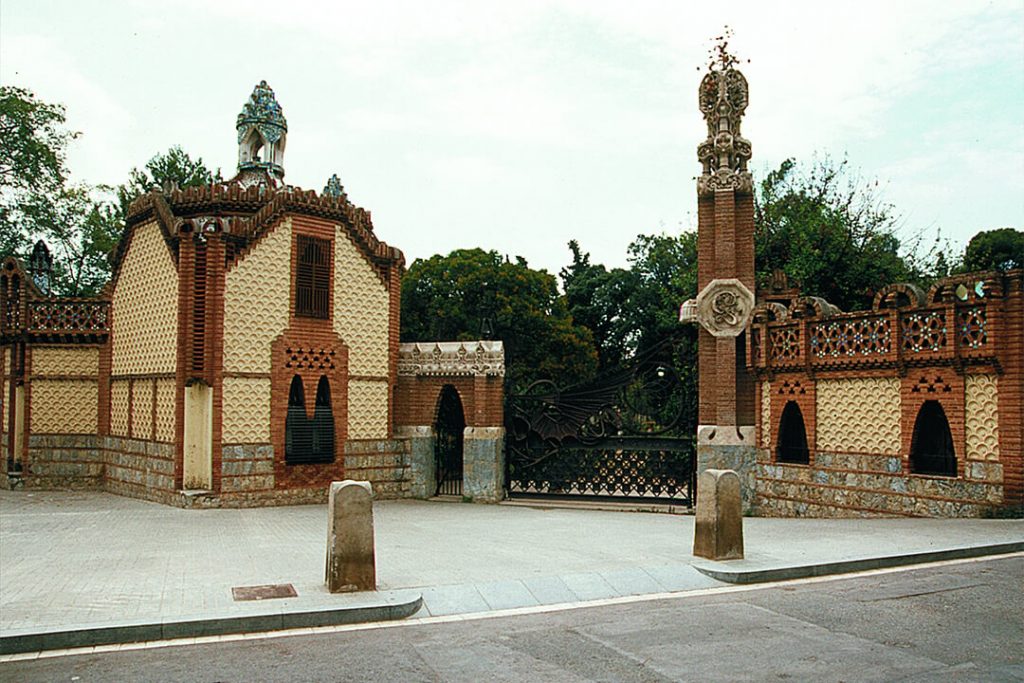
The main gate of Park Güell, featuring a brick wall decorated with mosaics, is protected by a wrought iron railing and flanked by two evocative pavilions that reproduce the story of Hansel and Gretel, which was performed as an opera at the Liceu in late 1900, the same period Gaudí began to design the Park Güell. The smaller one on the left with a double cross on the roof, is the house of the children Hansel and Gretel: it currently has a bookshop and souvenir shop on the ground floor. The house on the right, crowned by a poisonous toadstool-shaped dome, represents the Witch’s dwelling -interestingly, it was meant to be the house of the Park’s guard. It now houses the Interpretation Centre of the Park, part of the Barcelona History Museum (open daily from 11 a.m. to 3 p.m., tel. 932 856 899). The free-access ground floor has information on Gaudí’s work, but you must pay a fee to go upstairs to see the original house of the guard and the exhibition “Gaudí and Park Güell. Architecture and Nature”. Beyond the two pavilions, on the right one can see a kind of grotto supported by a central column that becomes wider at the top, as if it were a wine glass, meant as a shelter for carriages and horses on rainy days.
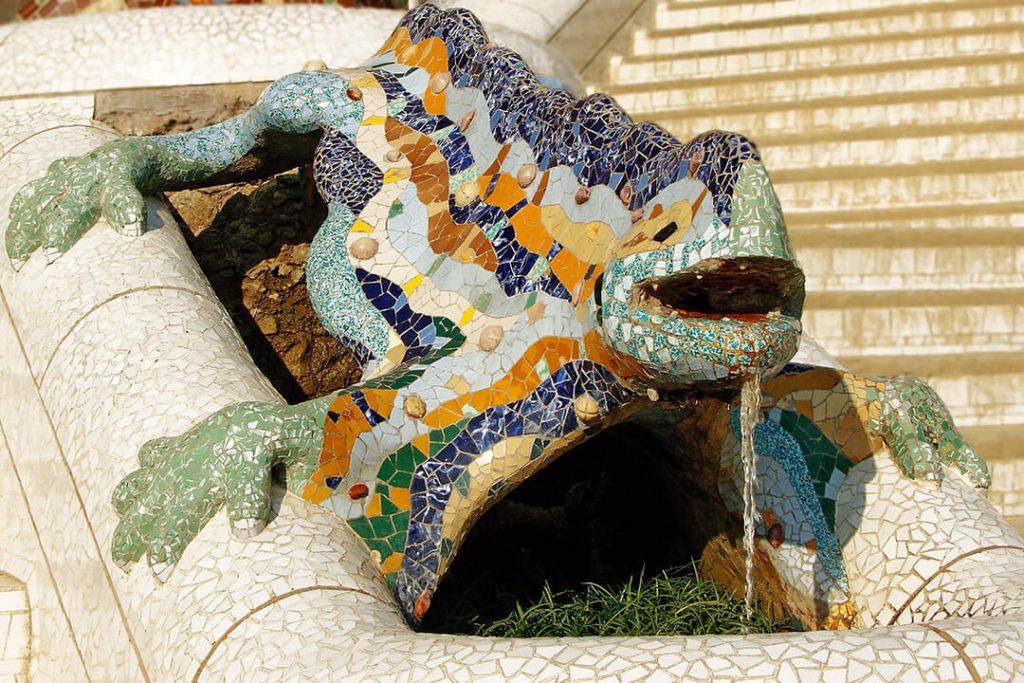
The main staircase is parted by a small waterfall featuring the famous multi-coloured dragon of glazed ceramic trencadís. The stairs lead to the hypostyle hall, also known as the Hall of the 100 Columns though it only has 86. This hall, originally intended to be the market of the future housing estate, was decorated by Gaudí’s assistant Josep Maria Jujol, who was given carte blanche to do so. The result was exceptional: an undulating ceiling of mosaic with varied incrustations forming capricious spirals. When this zone was restored in 1992 lights were added at the base of the columns, which create a spectacular resemblance to a Greek church at night. From the hypostyle hall two paths lead to the great circular square, a marvellous belvedere overlooking the city. According to Gaudí’s initial design, this square was to collect rainwater, channelled down inside the columns of the hypostyle hall to be collected in a huge cistern holding up to 12,000 cubic metres (not open to the public).
The square is surrounded by a winding bench of trencadís in which the imagination of Gaudí and Jujol achieved an extraordinary boldness, considered by some specialists a forerunner of abstract art. The bench is a symphony of colours: greens, blues and yellows are used in different combinations, forming moon shapes and stars and abstract flowers. Colour, however, fades away gradually from left to right, and at the far right the bench is mainly white, the symbol of purity. The bench seems to hint that human life is a kaleidoscope of colours that culminate after death in heavenly white. The white of this part of the bench is not, however, a pure white: here Gaudí used materials that had been rejected in other buildings, such as Casa Batlló, precisely because of the “impurity” of this white. The last restoration of the bench (1995) has maintained this imperfection by using up to 21 different hues and shades of white to replace the deteriorated parts.
Other unusual features of the Park Güell are its bridges and viaducts, with twisted, grotto-like columns. The fourth portico that connects the upper part with the lower part is perhaps the most Surrealist structure, with the leaning walls and arches that recall images by Dalí. The summit of the park is crowned by a monumental Calvary formed by three crosses at the place where Gaudí had planned to build the chapel. Even here the feverish architect had symbolic fantasies. If we look toward the east -toward Jerusalem, as it were- the perspective seems to merge all three crosses into one. This is the final point of the ascent: the cross is the ultimate symbol.
|
|
|
Predictably, the person entrusted with carrying
out Güell’s landscape planning scheme was Antoni
Gaudí. Gaudí’s project involved the construction
of a housing estate of 60 private plots and large common greens.
Gaudí devised the idea of a bucolic retreat for the
highest bourgeoisie of Barcelona. Its location on the hillside
and far from the city was ideal to symbolise the metaphor
of the ascent to paradise, to Eden. The project, however,
was a total failure. Development of the estate began between
1900 and 1904 and was definitively halted in 1914. One plot
was purchased by the owner of the construction company developing
the works, and two more plots were sold to a single purchaser,
who had only one villa built. As for the common facilities,
three crosses were built to mark the place where the chapel
was to be erected, but only the two entrance pavilions, the
retaining walls and all the road infrastructure around a large
square supported by columns were completed. As a result of
this financial disaster, the heirs of Eusebi Güell, who
died in 1918, sold the site to the City Council, and it was
decided to preserve it as a public park. The prodigious structures
raised among the typical Mediterranean vegetation are a curious
mixture of fantasy and spirituality, which the staunch patriot
Gaudí interspersed with Catalan emblems. A work, in
short, where Gaudí gave up his habitual historicism
and boldly chose a language of his own ranging from naturally-inspired
forms to a surprisingly avant-garde plasticity.
The main gate of Park Güell, featuring
a brick wall decorated with mosaics, is protected by a wrought
iron railing and flanked by two evocative pavilions that reproduce
the story of Hansel and Gretel, which was performed as an
opera at the Liceu in late 1900, the same period Gaudí
began to design the Park Güell. The smaller one on the
left with a double cross on the roof, is the house of the
children Hansel and Gretel: it currently has a bookshop and
souvenir shop on the ground floor. The house on the right,
crowned by a poisonous toadstool-shaped dome, represents the
Witch’s dwelling -interestingly, it was meant to be
the house of the Park’s guard. It now houses the Interpretation
Centre of the Park, part of the Barcelona History Museum (open
daily from 11 a.m. to 3 p.m., tel. 932 856 899). The free-access
ground floor has information on Gaudí’s work,
but you must pay a fee to go upstairs to see the original
house of the guard and the exhibition “Gaudí
and Park Güell. Architecture and Nature”. Beyond
the two pavilions, on the right one can see a kind of grotto
supported by a central column that becomes wider at the top,
as if it were a wine glass, meant as a shelter for carriages
and horses on rainy days.
The main staircase is parted by a small waterfall
featuring the famous multi-coloured dragon of glazed ceramic
trencadís. The stairs lead to the hypostyle hall, also
known as the Hall of the 100 Columns though it only has 86.
This hall, originally intended to be the market of the future
housing estate, was decorated by Gaudí’s assistant
Josep Maria Jujol, who was given carte blanche to do so. The
result was exceptional: an undulating ceiling of mosaic with
varied incrustations forming capricious spirals. When this
zone was restored in 1992 lights were added at the base of
the columns, which create a spectacular resemblance to a Greek
church at night. From the hypostyle hall two paths lead to
the great circular square, a marvellous belvedere overlooking
the city. According to Gaudí’s initial design,
this square was to collect rainwater, channelled down inside
the columns of the hypostyle hall to be collected in a huge
cistern holding up to 12,000 cubic metres (not open to the
public).
The square is surrounded by a winding bench
of trencadís in which the imagination of Gaudí
and Jujol achieved an extraordinary boldness, considered by
some specialists a forerunner of abstract art. The bench is
a symphony of colours: greens, blues and yellows are used
in different combinations, forming moon shapes and stars and
abstract flowers. Colour, however, fades away gradually from
left to right, and at the far right the bench is mainly white,
the symbol of purity. The bench seems to hint that human life
is a kaleidoscope of colours that culminate after death in
heavenly white. The white of this part of the bench is not,
however, a pure white: here Gaudí used materials that
had been rejected in other buildings, such as Casa Batlló,
precisely because of the “impurity” of this white.
The last restoration of the bench (1995) has maintained this
imperfection by using up to 21 different hues and shades of
white to replace the deteriorated parts.
|
 |